From the archive → 2017-12-26 • Grand Spiral Galaxy NGC 1232
Intro
One of the most popular websites at NASA is the Astronomy Picture of the Day. Each day a different image or photograph of our fascinating universe is featured, along with a brief explanation written by a professional astronomer.
Using the NASA Astronomy Picture of the Day API, link here, this site provides a new picture and description everyday. Using the input, the user can search for any day in the past. Enjoy all of the informative descriptions, beautiful images, and awesome videos. Discover the cosmos by exploring APODs throughout time!
Close
Get Astronomy Picture of the Day
Choose a date:
Close
APOD Info
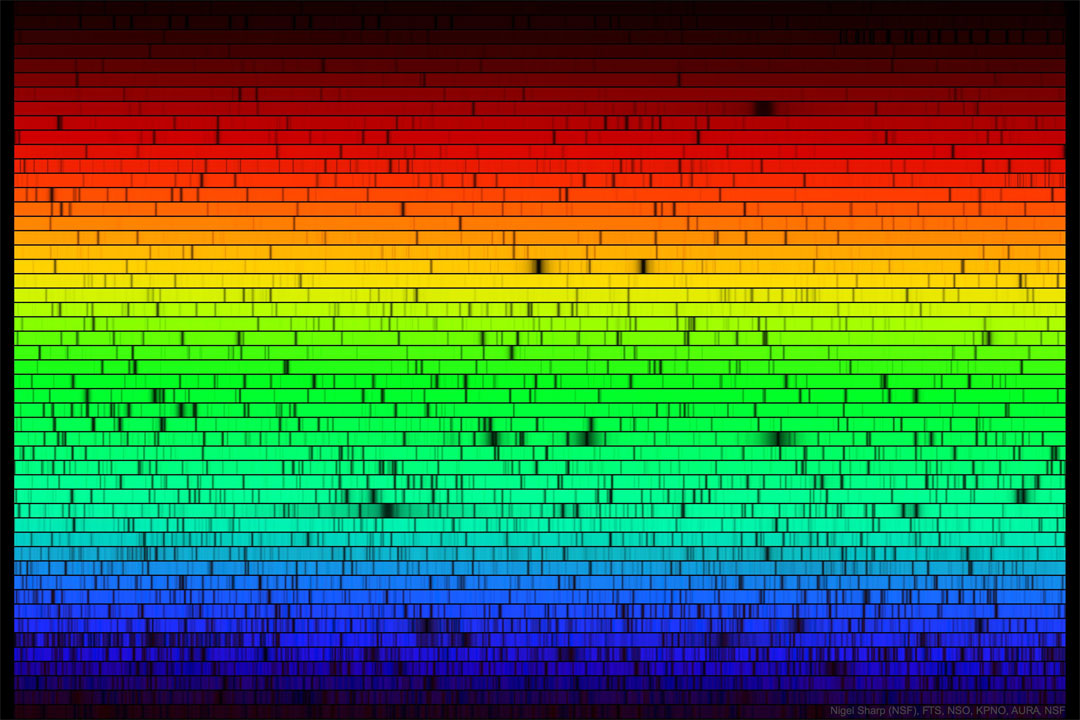
It is still not known why the Sun's light is missing some colors. Here are all the visible colors of the Sun, produced by passing the Sun's light through a prism-like device. The spectrum was created at the McMath-Pierce Solar Observatory and shows, first off, that although our white-appearing Sun emits light of nearly every color, it appears brightest in yellow-green light. The dark patches in the featured spectrum arise from gas at or above the Sun's surface absorbing sunlight emitted below. Since different types of gas absorb different colors of light, it is possible to determine what gasses compose the Sun. Helium, for example, was first discovered in 1868 on a solar spectrum and only later found here on Earth. Today, the majority of spectral absorption lines have been identified - but not all. Free APOD Lecture in Phoenix: Wednesday, December 10 at 7 pm
 From the archive → 2017-12-26 • Grand Spiral Galaxy NGC 1232